







Theresa Sapergia
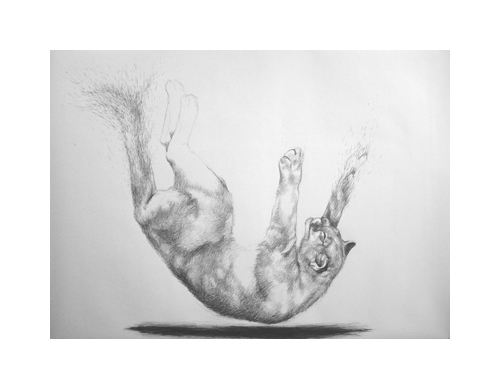
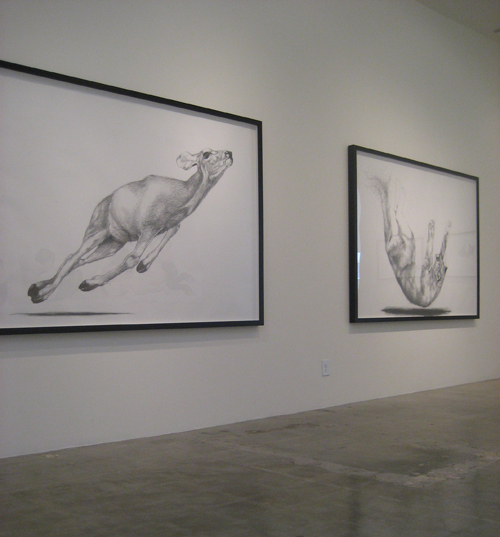
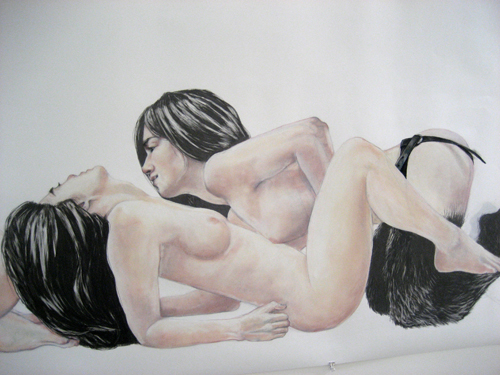
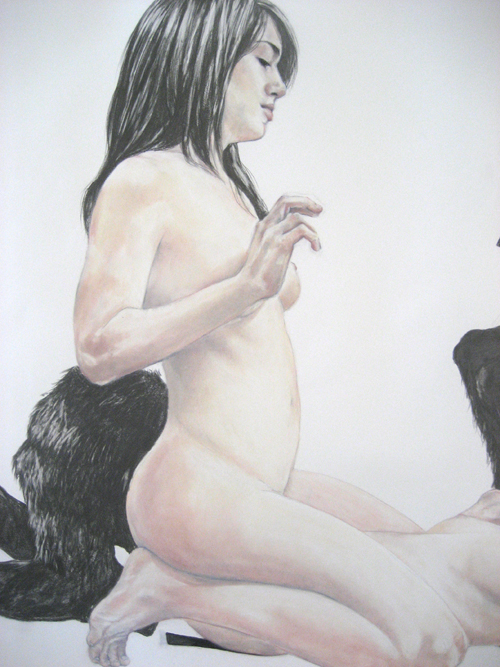
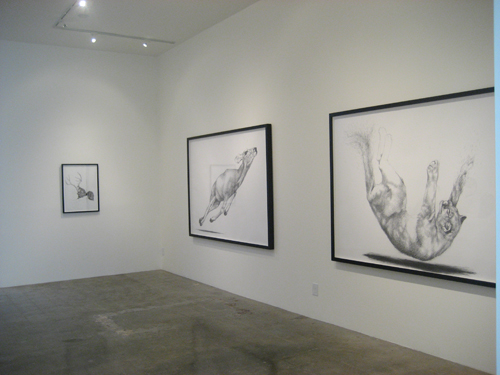
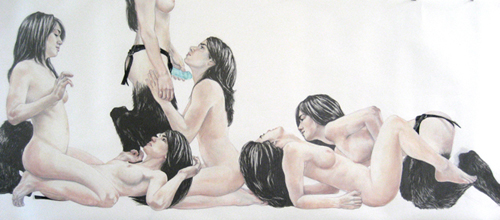
Theresa Sapergia’s show, A Thousand Natural Shocks, opened March 15th, 2008 at Cerasoli Gallery in Culver City, Los Angeles. Drawings, mostly large-scale and monochromatic, of various animals and one monumental depiction of the artist as both nymph and satyr hang in the front section of the gallery. The drawings have a tranquilized or sedated vibe to them, and yet there is also a drowsy yearning towards – for lack of a better word – nirvana.
Theresa Sapergia received a B.F.A. from Emily Carr Institute of Art and Design in Vancouver, B.C. and an M.F.A. from Concordia University in Montreal. She has exhibited at AIR Gallery in New York City, and across Canada in Vancouver, Toronto & Montreal. She currently lives and works in Prince George, British Columbia. Please read below for a full interview with the artist by Darrin Little.
 |
| Interview by Darrin Little for DailyServing – Photo Courtesy: Cerasoli Gallery |
DS: So, I want to congratulate you on your show. I thought I’d start with the title, A Thousand Natural Shocks. If you could maybe speak for a moment about how you arrived at that title…
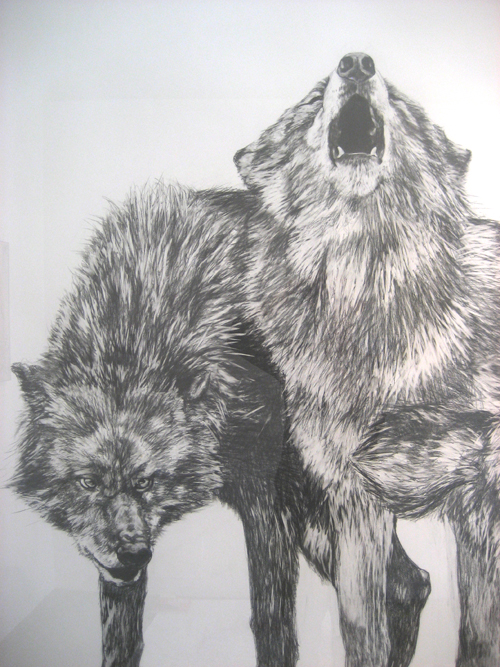
TS: A Thousand Natural Shocks which the show was originally going to be built around, it’s abnormally large…it’s very tall, so that piece sort of encompasses some of the themes that all of the work here is showing. There are these sorts of human floating figures, as well as wolf figures, maintaining the piece within the space of the drawing. So, A Thousand Natural Shocks is actually from a speech in Hamlet, “…a thousand natural shocks that flesh is heir to” It’s the ‘To Be Or Not To Be’ speech. But I like that sort of leveling that stretches across all bodies that, you know, flesh is heir to shock, whether it is a wolf or bear or human-we share that.
 |
| Photo Courtesy: Cerasoli Gallery |
DS: There seems to be the theme of rapture in the work. Is that accidental, or are you consciously trying to access this sort of emotional/spiritual state?
TS: I like the word “rapture” very much, but I don’t know if that was the intention. I think that for me it was starting with the idea of stillness. The idea of making anything at all, and that is that idea of holding something, of having something, of running it through your body and processing it. So it’s the animals and the human body that are floating there… sort of wanting to make things still for the moment so that you can look at it and experience it and process it. So they’re sort of thrown up, held and suspended there, while you’re able to be with it. And then they’re sort of exiting the representational space; there’s that representation and that stillness, and the possibility of that stillness falling apart and leaving the picture frame because you can’t hold, own or master these things. I suppose I was thinking of it in terms of that desire to hunt, have or to stop an animal long enough to experience the size, shape and feel of it. I think that those emotions are there when I make the work as well. So, it isn’t so much leaving as in rapture and going elsewhere, it’s just a kind of selfish holding.
 |
| Photo Courtesy: Cerasoli Gallery |
DS: So do you think of yourself as kind of a hunter?
TS: No, nothing that dramatic. But I grew up in a part of British Columbia where experiencing animals or the kind of ethos of hunting is always present. I respected it, to some extent, in a kind of sustenance way-not in a trophy kind of way. Also I understand the desire of the hunter, when you see into something and your excited by it, you want to stop it, and then unfortunately in some cases it goes to the extent of killing it, just so you can be near it. Mine is a much more mild desire, in that I can just articulate it and process it though my body, to make it into this image that I can then enjoy.
DS: In this show, I didn’t know what to expect. Freddi [Freddi Cerasoli] had not explicitly said which pieces were going to be in the show. I guess I was just expecting to see more animals…
TS: Oh, as opposed to the Satyrs and Nymphs?
DS: Exactly. So I think the choice, the decision to mix the animal drawings with the Satyr and Nymph drawing… well, they feed off each other so that one could entertain ideas of bestiality.
 |
| Photo Courtesy: Cerasoli Gallery |
TS: But I think the link is more about representation itself. If you take away what is being represented, the fundamental idea and the one idea that I continue to have is about representation… what does it mean to be representing, to be painting or drawing now? And that is the link I see going across the room: the representation of the animals are falling apart, leaving and exiting. And so the lie of three-dimensional, naturalistic representation is disassembling before your eyes, like a swarm of bugs that could just disappear. I think that we want to buy into the idea of three-dimensionality and realism. So to say, “look, you can’t have it – it’s fragile, it’s fleeting,” that’s present for me in those animal drawings. And then the idea of representation and what has been represented comes out even more for me with the Nymphs and Satyrs, because of course the Nymphs historically were used to represent women in painting.
DS: I was surprised to find out recently – not through your work specifically, but actually through a couple of paintings at the Norton Simon Museum – that you could have female Satyrs.
TS: It’s funny, now that I’ve been tattooing for a while I have seen them pop up in old tattoo flats, these sort of devilish women with these goat legs. For me that’s really exciting because they’re like women out of control. Their bodies are hairy and they’re taking up space and they’re being aggressive and they’re doing all of the things that they’re not supposed to do. So, I love that about the [female] Satyr. But that [The Satyr] is the physical embodiment of male lust, and so now that they’re women, what does that mean? She seems to me to be in control of it. She can remove her strap-on and she can not chase the Nymphs and she has her own stories. So it’s erased that idea of who’s looking.
DS: So are you saying that the subtext of the drawing of the Satyrs and the Nymphs is to remake the classic male notion of a Satyr, as a prisoner of some uncontrollable lust?
 |
| Photo Courtesy: Cerasoli Gallery |
TS: Well I think that’s one thread for it. But also the roles we play in representation, you know, what part are you allowed to play and which part is it proper to play? As a creator and as a viewer and a model…
DS: I had seen on this biography, I believe it was the Parisian Laundry website in which they have an opportunity to read a biography on you, and in this biography it mentions your interest in tattoos and that you were working as an apprentice with a tattoo artist. What’s the current status of your tattoo career?
TS: Well I did an apprenticeship in British Columbia and that actually instigated the move from East to West [Montreal to Prince George] and I am now tattooing in British Columbia.
DS: In what way do you find that influencing your art production – that is shown in galleries? Is there a crossover?
|
|
| Photo Courtesy: Cerasoli Gallery |
TS: I think there will inevitably be, but right now they seem so similar, because I’ve always had nothing but the context of the materials, just the raw canvas and just the paper, these are the basic materials, and here they are. And what is so similar is that I’m able to put my images onto this beautiful floating and moving surface, or into the surface rather, so it seems very similar. And the imagery that has always attracted m – I think we just keep coming back to the same idea most of our lives anyway, trying to figure out my relationship to desire and to death and bodies and gravity – all of those things are still there. I don’t know if it’s going to lead directly to putting hearts and sparrows into paintings, but I find the imagery of tattooing really exciting, so it’s possible.
DS: Or going the other way, do you foresee a time when you could reach for human skin instead of the canvas to depict an image?
TS: I would like that very much. It’s going to happen as I develop more skill with the tools of tattooing, because I’m not as comfortable with them as I am with the tools of drawing and painting… it’s funny because the imagery of tattooing is actually not so different than what I’ve been making – you know, the bears and wolves and cougars and what not are already there.
DS: Hot girls wearing dildos?
 |
| Photo Courtesy: Cerasoli Gallery |
TS: Yeah. But you know it’s funny because it simplifies all these grizzly, gut-wrenching thoughts I’ve had into these base desires, and it really makes me think of someone who criticized me once by saying that I make art like a teenage boy… that my desires are so simple.
DS: That sounds like a lot of fuel for a feminist rebuttal, I mean, can’t teenage girls have thoughts like that?
TS: Well, they’re not expected to – they just sort of react to the boys’ thoughts. I think that’s the expectation.
Theresa Sapergia’s exhibition at the Cerasoli Gallery will be on view through April 5th.





